
At OvobankUS, finding the ideal donor for our patients is one of the most important stages in the egg donation process. For this purpose, our specialist matching team conducts a rigorous search of all our donors, selecting only those who are compatible with the patient. When we talk about compatibility, we mean both from a phenotypic and genetic point of view. In this article, we explain the importance of genetic compatibility in the selection of an egg donor.
Ovodonation is an assisted reproduction treatment that follows the same procedure as In Vitro Fertilization (IVF), but in this case, the union of the egg and the sperm is performed with an open-identity donor’s egg from OvobankUS Egg Bank.
The Genetic Compatibility Test (GCT), also known as Genetic Matching, is an innovative technique that allows us to minimize the transmission of genetic diseases to children born from donor eggs.
Most healthy people carry a recessive gene mutation, but they don’t display that trait or show symptoms of the disease. With this test, the genetic information will be compared in order to exclude shared mutations in the same genes and consequently, increase the chances of having a healthy baby.
OVOBANK’S RIGOROUS EGG DONOR SCREENING PROCESS
OvobankUS has an extensive egg donor pool with diverse phenotypes and nationalities. Our egg donors are women aged between 18 and 33, who are in good physical and mental health. To ensure this, a series of exhaustive gynecological, psychological, serological and genetic tests are carried out. Ovobank’s exclusion criteria are very strict, so just one third of potential donors are selected in our rigorous egg-donor screening process. Seventy-three percent of the rejected candidates are excluded for medical reasons (such as a family history of diseases like epilepsy or thalassemia, etc.).
Since 2016, we’ve been offering clinics and patients the possibility to go one step further in the genetic study, by performing the Genetic Compatibility Test between the egg donor and the genetic father. In this way, we can analyze the genetic information to make sure they don’t share any of the recessive mutations studied, thus reducing the risk of transmitting a genetic disease to the baby.
HOW IS THE GENETIC MATCHING PROCESS CARRIED OUT?
As shown in the infographic below, a simple blood test is carried out on the egg donor and on the genetic father. The results will confirm if they share the same genetic mutation, and consequently, whether they are compatible or not.
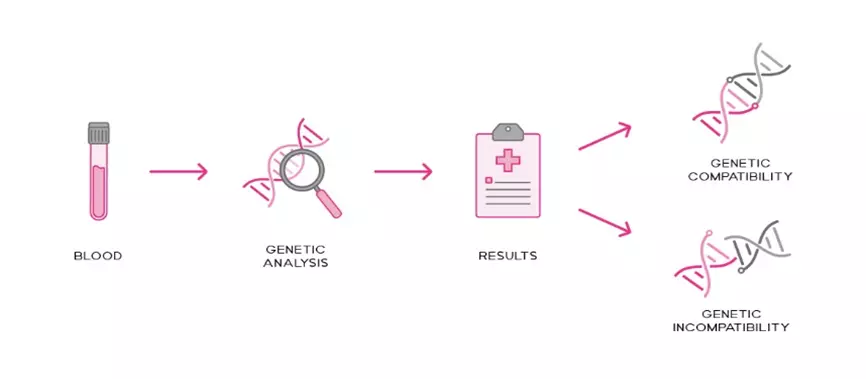
Genetic Compatibility Test (GCT)
At OvobankUS, we perform extensive genetic studies on all of our donors to exclude any possible carriers of recessive mutations that could lead to genetic diseases.
Thanks to new technological advances and the study of the exome, more than 50,000 mutations in more than 2,000 genes can be screened. It’s possible to perform genetic matching with the various genetic panels on the market, and cater to any specific genetic diagnosis at the request of the fertility clinic or patient. This means that patients who request this study can proceed with their treatment with absolute peace of mind, and fulfill their dream of having a healthy baby.
If you’re considering starting an egg donation process, and you’ve got doubts about how to go about selecting your ideal donor, don’t hesitate to contact us!
Our specialized team will be happy to advise you: info@ovobankus.com